



The magazine of innovation in Africa

Pli: the Libreville-built tool that deletes your secrets once they are read
Published yesterday
A password sent by email, forgotten, then exposed months later when someone else’s inbox was hacked. That everyday slip is what sparked Pli, a Gabonese service that encrypts your secrets right in the browser and wipes them after a single read. Its founder, Romaric Banga, tells how he built it.
Taking away the power to read
Banga looked at existing tools. In his view, the best-known ones in this category encrypt data on their own servers, which means they can technically read it. So he set two rules before writing a line of code.
The first: “I didn’t want a service that politely chooses not to read. I wanted to remove the power to read.” The second: every secret needs an expiry date. “The only copy that never leaks is the one that no longer exists.”
What Pli changes in everyday life
Sending a visa application without it sitting in a chat thread for years. Passing a login to a colleague without leaving a trace in their inbox. Sending a payslip without it lingering in a message history. Pli is built for individuals, for people who share secrets at work every day, and for small organisations with no IT department.
There is no account, no sign-up and nothing to install. You open the page, drop your content and get a link. The page is deliberately light so it loads on an entry-level phone with a limited data plan. “Pli doesn’t replace WhatsApp,” Banga says. “It replaces the message you shouldn’t have left there.”
How it works: a locker, not a reader
- In the sender’s browser, a key is generated and the content is encrypted before anything is sent, using the standard cryptography built into browsers.
- Over the network, only an unreadable block and an expiry time travel. The server never sees the key, the file names, or even what kind of content it holds.
- The key travels inside the link, in the part after the # sign. Under the rules of the web, that part is never sent to the server.
- To open it, the recipient has to take a deliberate action, so automatic link previews in messaging apps and antivirus tools that scan links do not use it up.
- Once read, the content is destroyed in a single step. A link that has been read, has expired or never existed gets exactly the same response.
“The server is a locker, not a reader,” Banga sums up. “It stores a block it cannot open, hands it over once, then destroys it.”
The neighbourhood cybercafé
The second idea came from a friend, Dimitri Ongoua. He receives a certificate or an invoice on his phone, has no printer, and goes to the local cybercafé. To print, he has to use a USB stick or log into his email on someone else’s computer. The file stays in the downloads folder, and sometimes the session stays open for the next customer.
“It was exactly the same wound that started the project, in a different setting,” Banga says. “The first time, it was time. This time, it was place.” So Pli now has a print mode: the document opens, goes straight to the printer without being saved on the machine, and the secret is destroyed.
The same scene plays out in Libreville, Abidjan, Dakar or Douala, and far beyond Africa: anywhere people print documents on a computer that isn’t theirs.
A step forward for everyday cybersecurity
Cybersecurity is often left to companies and specialists. Pli puts it in everyone’s pocket. In-browser encryption, no account, deletion after reading, printing without a trace: protections usually associated with professional tools, available through a single link on an entry-level phone.
Another rare trait: Banga does not oversell his product. Its limits are written plainly in the app. “A limit you write down can be worked around. A hidden limit is discovered at the worst possible moment.”
One month, 35 secrets
The first real send revealed a flaw the same day: the link arrived with no title or preview image, which made it look like a phishing link. It was fixed in the first week.
Users’ first question is not about security. It is “Did they open it?” Banga refused to build a dashboard, which would have meant keeping a record of who sends what. Instead, senders get a tracking number that answers only “opened” or nothing.
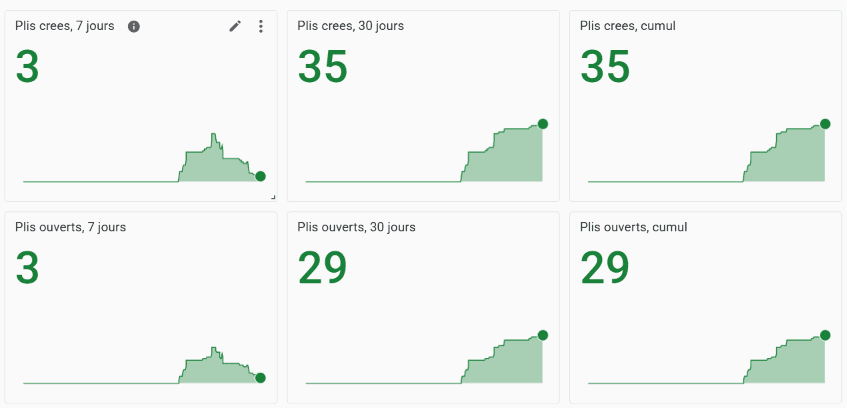
The figures are small, and Banga is precise about where they start: 35 secrets created and 29 opened between 30 September 2026, the day he set up his counters, and 16 October. Anything sent before that is not counted anywhere. So more than eight in ten reach their recipient. “The service counts secrets, not people,” he says.
Building from Libreville
The hardest part is not technical but financial. According to Banga, the major online payment platforms do not open merchant accounts in Gabon. And people there do not pay by card subscription: they pay by mobile money, when they need something.
Those constraints shaped the product: photos compressed before sending, a light page, printing without downloading, no account. Even the decision not to build a dashboard comes from there: people change phones, use a cybercafé computer, wipe their data. “A dashboard would be empty for exactly the people the product is built for.”
“The constraints here built the product, and they made it better everywhere else too.”
What comes next: Gabon, then French-speaking Africa
Pli already works from any country. For its founder, expanding means opening local payments, language and trust. First, he wants to grow usage in Gabon and add mobile money, while keeping a free tier that stays complete. Next come Cameroon, Côte d’Ivoire and Senegal, where mobile money and language are the same, then an offer for businesses and an English version of the interface.
Banga’s own words sum up what he built: “The same problem keeps coming back: a secret that outlives its purpose, in a place that isn’t yours.” Pli exists so that this secret doesn’t.
A password to share, a file to send, a document to print at a cybercafé? Pli works anywhere, on any phone, with no account and nothing to install.
Discover Pli